
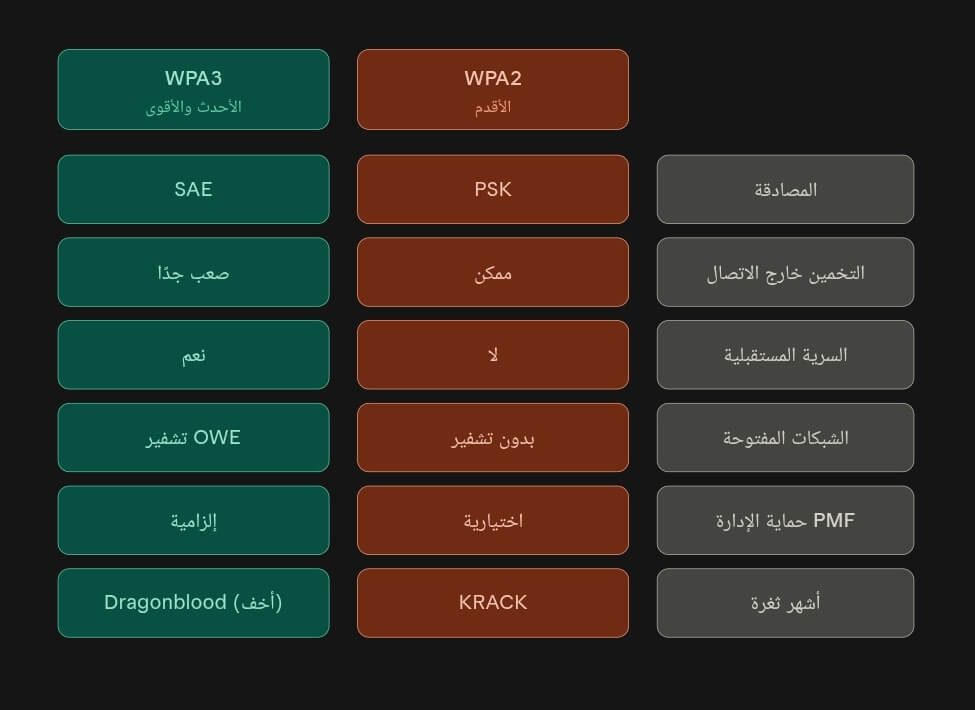
The essential difference: WPA3 is newer and stronger, and it protects you even if the password is relatively weak, whereas WPA2 is weaker against guessing attacks.
The main differences:
1 - Authentication: WPA2 uses PSK (a pre-shared key), while WPA3 uses SAE (simultaneous authentication of equals), which prevents offline dictionary attacks on the password.
2 - Protection against guessing: With WPA2 an attacker can capture the handshake and then try millions of words on his own machine. With WPA3 every attempt requires direct interaction with the network, which makes guessing extremely slow.
3 - Forward secrecy: With WPA3, if the password is compromised later, previously recorded traffic cannot be decrypted. With WPA2 it can.
4 - Encryption strength: WPA2 generally relies on AES-128; WPA3-Personal uses AES-128 (GCMP-128), and WPA3-Enterprise goes up to 192-bit.
5 - Open networks: WPA3 adds OWE, which automatically encrypts open public networks that have no password, whereas WPA2 leaves them unencrypted.
6 - Protected management frames (PMF): Optional in WPA2 and mandatory in WPA3, it prevents deauthentication attacks.
7 - Known vulnerabilities: WPA2 was affected by the KRACK attack, and WPA3 was designed to withstand it (though less severe weaknesses such as Dragonblood appeared later).
In practice: If your router and your devices support WPA3, use it; otherwise choose the mixed WPA2/WPA3 mode for compatibility with older devices, together with a long, strong password.




























 English
 Arabic
