
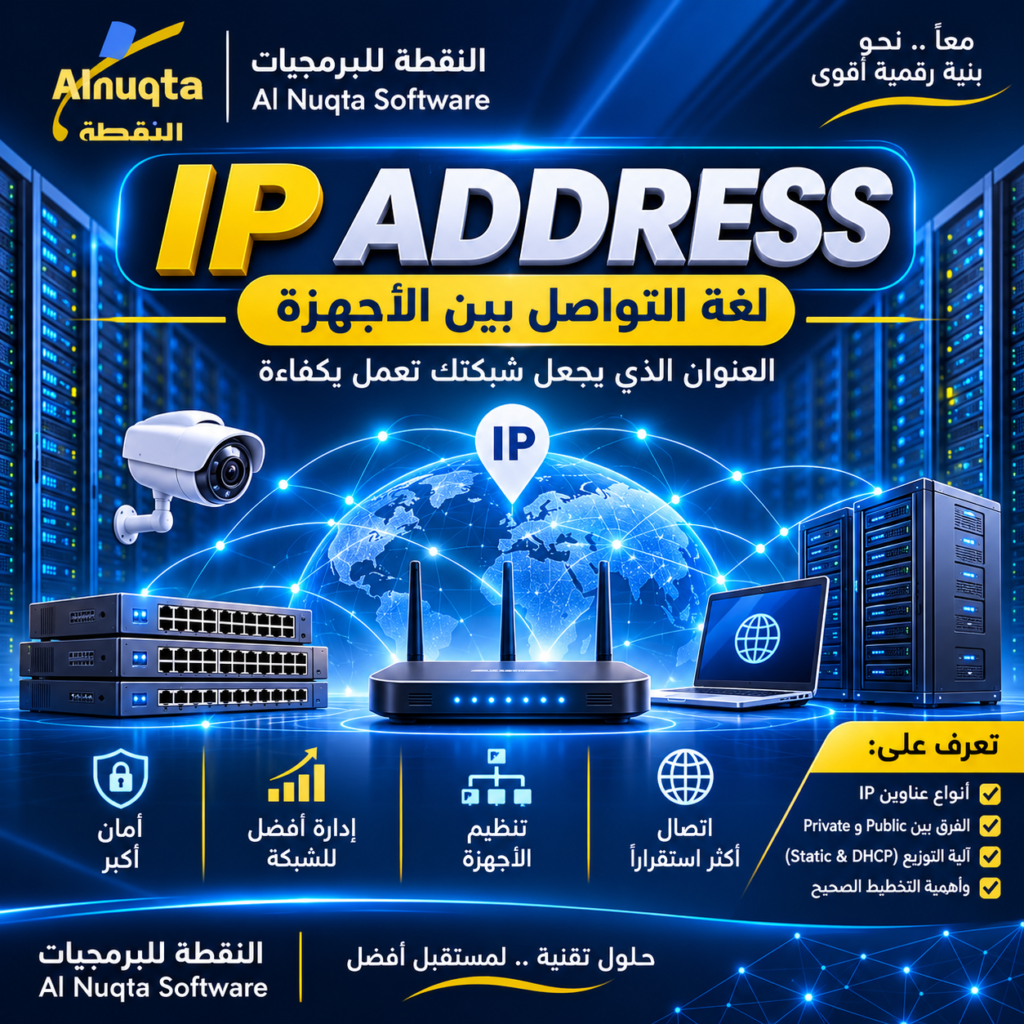
Have you ever wondered how a computer knows where to send data? How a server communicates with another machine, or how surveillance cameras carry the picture to the recorder across the network?
The answer starts with a basic concept in information technology known as the IP Address (Internet Protocol Address).
Put simply, an IP address is a numeric address used to identify devices on a network. It organises the sending and receiving of data and routes it to the correct destination. Just as every house needs an address for services and post to reach it, devices on a network need addresses that let them communicate with one another.
What are the types of IP addresses?
▪️ IPv4: The most widely used type, made up of four numeric parts, such as `192.168.1.10`.
▪️ IPv6: A newer version that provides a vast address space to keep pace with the continuous growth of devices and systems connected to the internet.
What is the difference between a Public IP and a Private IP?
▪️ Public IP: An address used to connect over the internet, assigned according to the service provider's or the network administrator's scheme.
▪️ Private IP: An address used inside local networks, such as company and home networks, to connect computers, servers, printers and surveillance cameras.
How are IP addresses assigned?
Addresses are assigned either manually and statically (a static IP), which suits devices that need a permanent address such as servers, recorders and cameras, or automatically through DHCP, which distributes network settings to devices without any need to configure them by hand.
Why is organizing IP addresses important?
Planning network addresses correctly is not only about guaranteeing connectivity between devices; it is a fundamental step in building professional infrastructure, and it helps to:
- Organise devices and services within the organisation.
- Reduce network address conflicts.
- Strengthen protection and access control.
- Separate the staff, server and camera networks.
- Make maintenance, development and future expansion easier.
Understanding IP addresses is the first step towards a deeper understanding of networking, servers, cybersecurity and digital infrastructure.
A successful network does not start merely with connecting devices; it starts with sound planning that lets every device know its place and every connection reach its destination.
| ALNUQTA Software | Technical solutions, infrastructure and integrated networks |
|---|
#ALNUQTA_Software #AlNuqta #Networking #IP_Address #IT_Infrastructure #CyberSecurity #DigitalTransformation


























 English
 Arabic
