
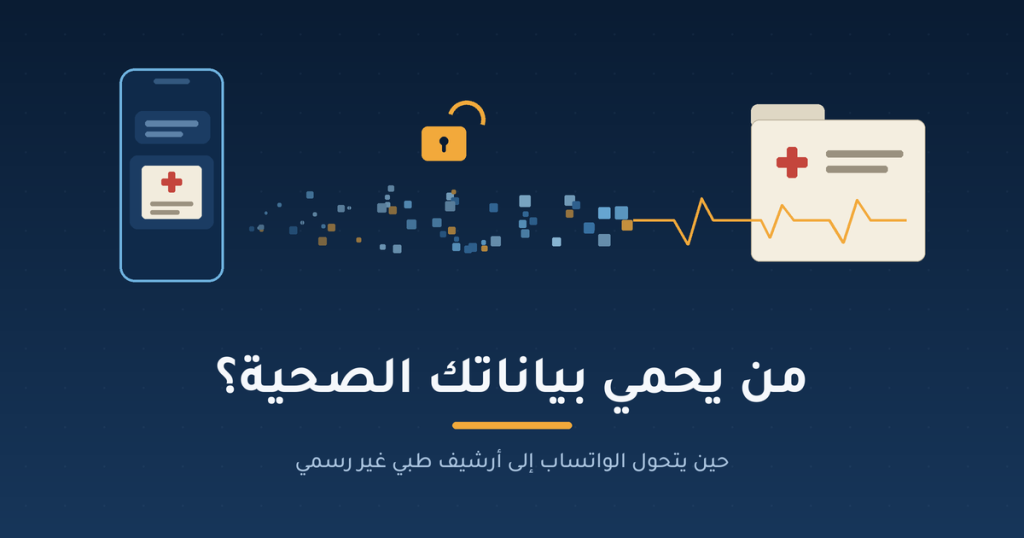
The scene is so familiar that we no longer notice it. A test result sent as a photo to a WhatsApp group called "Lab results", an X-ray image saved on a receptionist's personal phone, and a complete patient file moving from one device to another because the printer is broken. Without meaning to, WhatsApp has become an unofficial medical archive here, guarded by nobody and answerable to nobody.
And the question we all avoid: if these files reached the wrong person, who would be responsible?
Why would anyone buy your medical history?
On the black market, a medical record is worth many times more than a credit card. The reason is simple: you can cancel a stolen card with one phone call or a tap in your bank's app, but your medical history cannot be cancelled or changed. It is you.
This data is used for blackmail, insurance fraud and identity theft. And in our societies in particular it has an extra price: a leaked diagnosis can cost its owner a job, an engagement or a whole family's reputation. We handle the most dangerous kind of data with the least caution.
Leaks do not look like the movies
When we hear the word hack, we imagine hackers in a dark room. The reality here is less exciting and more dangerous: an employee who takes a photo of the screen to save time, a lab device connected to the internet with a password unchanged since it was installed, a reception computer left open for anyone who walks by, and old devices sold in the market with thousands of files nobody deleted.
A big hack happens once every few years. Small leaks happen every day, usually with no bad intent, and that is exactly what makes them more dangerous: nobody even considers them a crime.
A gap that reads like an open invitation
In the United States, leaking a single medical file can cost an institution millions of dollars in fines under the HIPAA law. In Europe, the GDPR made data protection an existential matter for any healthcare institution. The result is not that their hospitals are more ethical, but that leaks are costly for them.
Here the equation is reversed. There is no clear dedicated law protecting health data, no supervisory body that audits, and no fine that deters. A hospital that leaks data loses nothing, so why would it invest in protection? When the cost of negligence is zero, negligence becomes an unannounced policy.
What should institutions do?
Protection is not a firewall bought once and forgotten, but a set of daily habits.
Encryption of data in storage and in transit; graded permissions so the receptionist does not see what the treating doctor sees; and an access log that answers one question: who opened this file, when and why? Then regular staff training, because the strongest system in the world falls to an employee who writes the password on a note stuck to the screen. And finally a clear policy with no exceptions: medical data does not leave the institution's systems for personal phones, however good the intention.
You are a guardian too
Part of the protection is in the patient's own hands. Ask your lab how it sends results and whether there is an alternative to public groups. Do not attach your medical reports to social media posts: an innocent prayer post with a photo of a test result reveals your diagnosis to thousands of strangers, forever. And when you replace your phone or sell your computer, make sure your files are not still inside.
These are not excessive worries. This is the same digital hygiene we teach our children about passwords, applied to the most precious thing we own.
A file is not just paper
A medical file is not an administrative document. It is the story of a person's body and mind: their illnesses, their medicines and their moments of weakness, entrusted to a party that is supposed to deserve that trust. Protecting it is not a technical luxury hospitals boast about in their adverts, but a direct extension of the oldest pledge in the medical profession: first, do no harm.
Digital transformation promised us a file that moves with us easily, and that is a gain we do not want to give up. But convenience without protection is not progress; it is a back door left wide open. And the question that should come before any health digitisation project from today on is not "how much will the system cost?" but "who will protect what we put in it?"


























 English
 Arabic
