
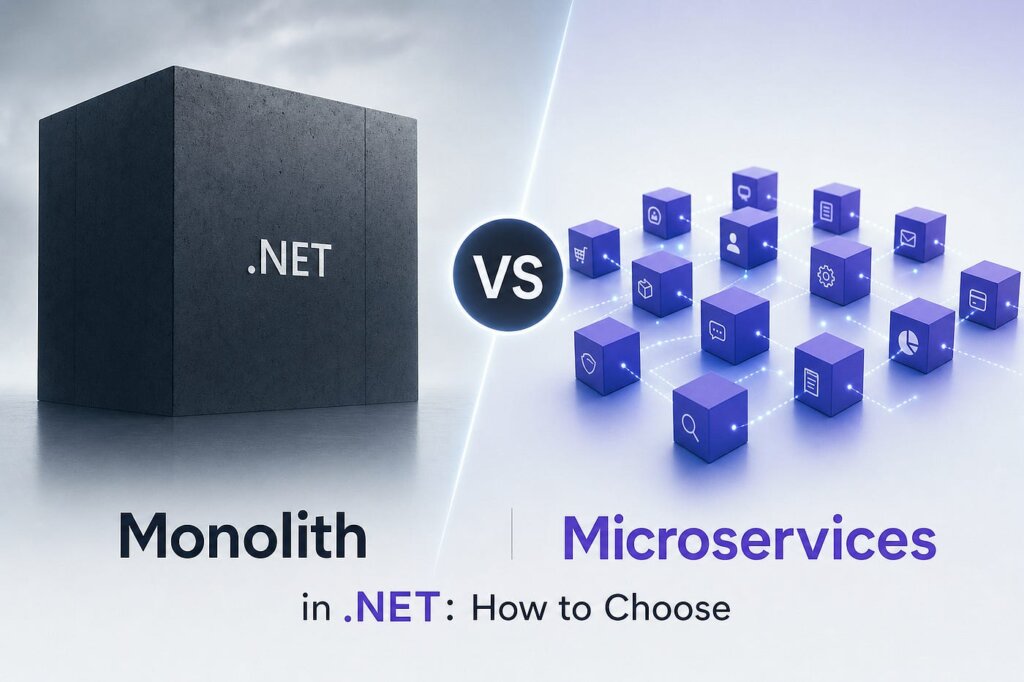
Monolith or microservices? Which is better for building systems with .NET?
Monolith vs Microservices
In the world of software development, some developers believe that moving to microservices is proof of a system's maturity and a team's professionalism, while others see the monolith as an outdated approach that no longer suits modern projects.
But the engineering reality is quite different: the most complex architecture is not the best one; the best architecture is the one that meets the project's requirements with the lowest possible cost and complexity.
First: the monolith
Monolithic Architecture
This approach builds the system as a single, integrated application that contains all its functions, such as managing users, products, orders and payments, while still allowing them to be organized internally into clear layers with separate responsibilities.
In a .NET environment, you can use:
ASP.NET Core MVC
ASP.NET Core Web API
And the project can be organized using:
Clean Architecture
so that business logic is separated from the user interface and technical details, without having to turn every function into a separate service.
Key advantages:
- Easy to develop, test, deploy and maintain.
- Faster project delivery and product launches.
- Easy to trace errors and to run interdependent operations.
- Lower operating and infrastructure costs.
- Capable of building large, reliable enterprise systems.
Main drawbacks:
As the system grows without good organization, changes can become harder, and an unhandled error in one part can affect the entire application.
But these problems are not proof that the architecture has failed; many of them stem from weak design and poor code quality.
Second: microservices
Microservices Architecture
This architecture splits the system into a set of independent services, each responsible for a specific business capability, which can be developed, tested and deployed separately.
For example, an online store can be split into services for identity, products, orders and notifications.
In .NET, each service can be built using:
ASP.NET Core Web API
Services communicate with each other through APIs, or through messaging systems when needed.
HTTP / REST
RabbitMQ / MassTransit
And a single entry point to the services can be provided using:
YARP Reverse Proxy
Key advantages:
- Each service can be developed and deployed independently.
- Responsibilities are clearly divided between development teams.
- Resources can be allocated to the services that need more capacity.
- The impact of some failures is reduced when services are designed to handle communication failures.
- Teams gain more independence in developing parts of the system.
Main drawbacks:
- Greater complexity in development, operations and monitoring.
- The possibility of communication failures between services.
- Difficulty tracing operations that pass through multiple services.
- The need to manage communication and security and to handle failures.
- Higher requirements for testing, deployment and version management.
This brings out an important point: Microservices do not eliminate complexity; they move part of it from inside the application to the communication and operational infrastructure between services.
Third: what about performance and scalability?
Performance & Scalability
It is not true that microservices are always faster than a monolith.
In a monolith, most calls between components happen within the same process, which reduces the need for network communication.
With microservices, some operations require external calls that can add latency and the possibility of failure.
On the other hand, microservices let you add resources to a specific service independently, while a monolith can also be scaled by running multiple instances and distributing requests between them.
Therefore, performance is not determined by the name of the architecture, but by the quality of design and implementation and the nature of the workload.
Fourth: when should you choose each architecture?
If you are developing a university management system, an online store, or an accounting and enterprise resource planning system, with a small or medium-sized team working on it, a well-organized monolith may be the most efficient choice in terms of development, maintenance and cost.
If, however, the project involves multiple teams that need independent release cycles, services with different operational requirements, and clear boundaries between responsibilities, microservices may be a logical choice.
But project size alone does not require microservices; a well-designed monolith can serve large numbers of users with high efficiency.
Fifth: should you start with microservices?
Not necessarily.
A good engineering decision is to start with a well-organized monolith with clearly separated responsibilities, and then extract independent services when a real need for them arises.
Modular Monolith
This approach can be adopted when clearer organizational boundaries are needed inside the application, without taking on the operational complexity of microservices from the start.
However, not every project needs this degree of separation; well-organized traditional layers may be entirely sufficient.
Conclusion
No architecture outperforms the other in every scenario.
The monolith is not an outdated architecture, and microservices are not a mandatory upgrade for every successful project.
Good software engineering does not mean using as many technologies and architectural patterns as possible; it means making the right decisions based on actual requirements.
Ultimately, with .NET you can build professional, scalable and maintainable systems with either approach.
And the most important rule worth always remembering:
Start simple, maintain design quality, and do not add engineering complexity before you have a real problem that calls for it.
Simplicity Is King.



 English
 Arabic