
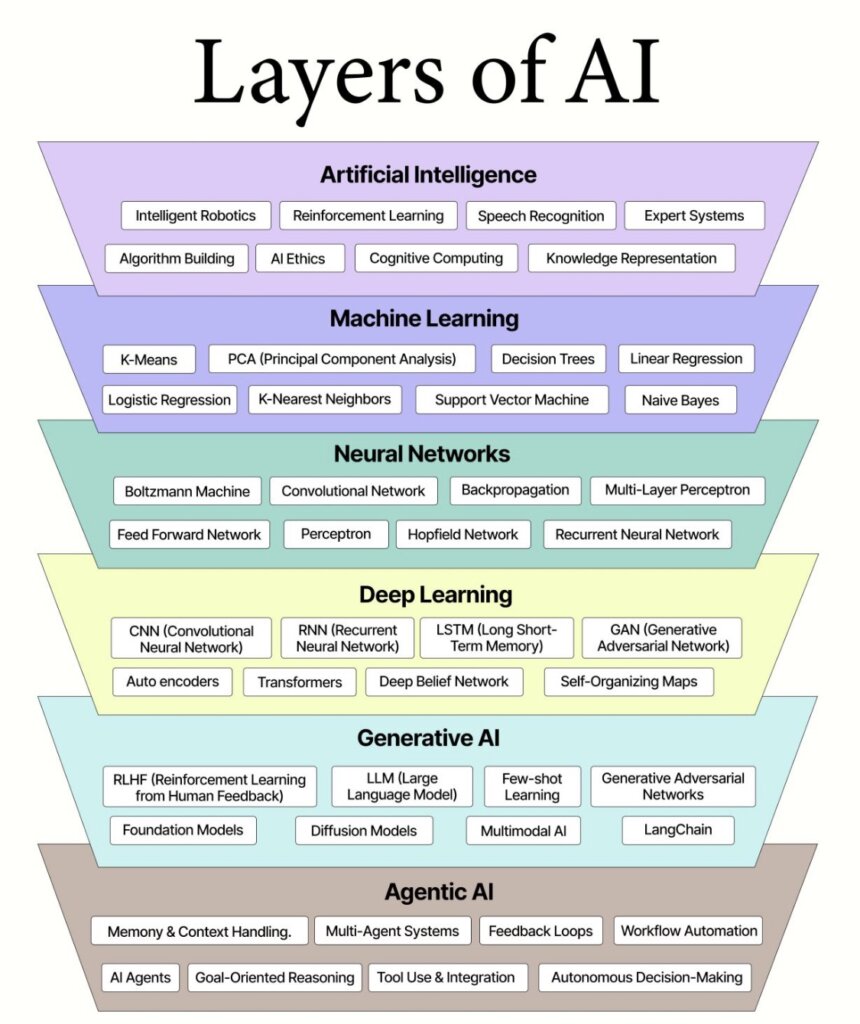
Read this pyramid from the bottom up: why do "AI agents" actually work?
Everyone reads this pyramid, or chart, from the top down: artificial intelligence first, then machine learning, then the rest. But what if we started from the bottom instead? The real picture then becomes clear, and it explains why AI agent systems work and succeed.
1. What agentic AI systems need
• Goal-oriented reasoning
• Tool use & integration
• Memory & context handling
• Feedback loops
2. The generative foundation
To perform their tasks, these systems rely on generative AI, which includes:
• Large language models (LLMs), foundation models and multimodal AI.
• Few-shot learning and feedback-based learning techniques for following instructions accurately.
3. Deep learning architecture
Which in turn is built using:
• Transformer models, along with convolutional neural networks (CNNs), recurrent neural networks (RNNs) and LSTMs.
4. Neural networks
Which are made up of basic building blocks such as:
• Perceptrons, backpropagation algorithms and multi-layer networks.
5. Machine learning
Under which fall concepts such as:
• Regression, decision trees, support vector machines (SVMs) and clustering.
6. Artificial intelligence as a whole
Which sits under the broadest umbrella, including:
• Robotics, expert systems, speech recognition and technology ethics.
Conclusion
Agents are nothing more than the newest floor of the same building.
That is exactly why the "just add an agent" approach fails: when the underlying model is weak, when the system lacks memory, or when the tools are not properly connected to each other.
The solution never lies at the top.
——————————-
Read this chart from the bottom up.
Everyone reads it top-down: Al, then ML, then the rest. Start at the bottom instead, and it explains why agents work.
Agentic Al needs:
L Goal-oriented reasoning
L Tool use & integration
L Memory & context handling
L Feedback loops
To do that, it runs on Generative Al L LLMs, foundation models, multimodal Al L Few-shot learning and RLF to follow instructions
Which is built with Deep Learning
— Transformers, plus CNNS, RNNS, LSTMS
Which is made of Neural Networks
L Perceptrons, backpropagation, multi-layer networks
Which is a branch of Machine Learning L Regression, decision trees, SVMs, clustering
Which sits inside Artificial Intelligence
L Robotics, expert systems, speech recognition, ethics
Agents are the newest floor of the same building.
That's why "just add an agent" fails when the model underneath is weak, the memory is missing, or the tools aren't connected.
The fix is almost never at the top.


 English
 Arabic