
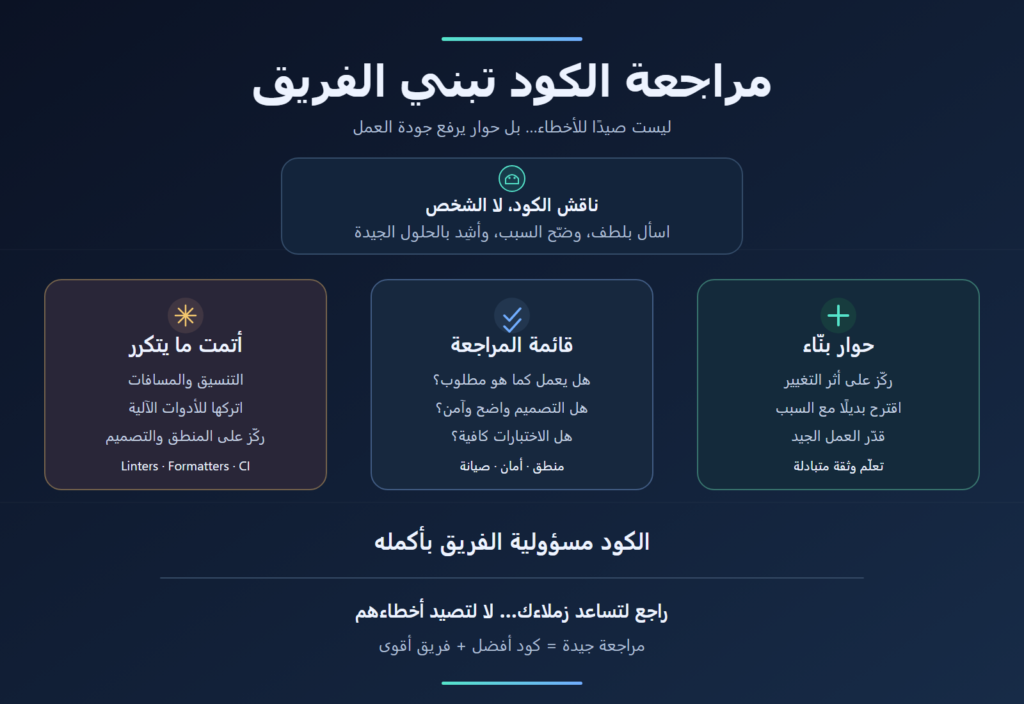
Code review is not just a quality gate for merging changes into the main branch. It is the real place where a development team's culture forms and where practical, everyday experience passes between its members.
When code review is run badly, it turns into an arena of personal criticism and frustration. When it is run well, it strengthens shared ownership of the code and speeds up the growth of new developers.
1. Turning review from "bug hunting" into a learning conversation
For the process to work, the team has to agree on how it communicates:
Separate the person from the code:
Poor wording: "You did not understand how to use this function and wrote slow code."
Constructive wording: "Could we use function X here instead of Y to improve response time and save memory?"
Explain why you ask for a change: do not request a change just because of a personal formatting preference. If it is about performance, architecture or security, state the reason or link to a source that explains it.
Praise good code: code review is not only for negative comments. If a colleague found a creative solution or wrote very clean code, add a positive comment to lift the team's spirit.
2. A practical code review checklist
To avoid getting lost during a review, it helps to look at the code in graded levels:
- 1. Functionality: does the code meet the feature's requirements without side bugs?
- 2. Design and architecture: does it follow the project's structure and the separation of responsibilities?
- 3. Security and performance: are there security holes or expensive database queries?
- 4. Test coverage: are there unit tests covering the main and edge cases?
- 5. Maintainability: are the names clear, and is the code easy to read and audit?
3. Automate what can be automated (automation first)
The biggest mistake developers make during code review is spending time arguing about spacing (tabs vs spaces), brackets or formatting rules.
The fix: leave these details entirely to linters, formatters and CI/CD tools.
Keep human code review for the business logic, the architecture and the development experience.
Conclusion
A successful development team sees code review as a daily chance to share knowledge and reduce risk. The code in the system is the whole team's responsibility, not only the responsibility of the person who wrote it.


























 English
 Arabic
