
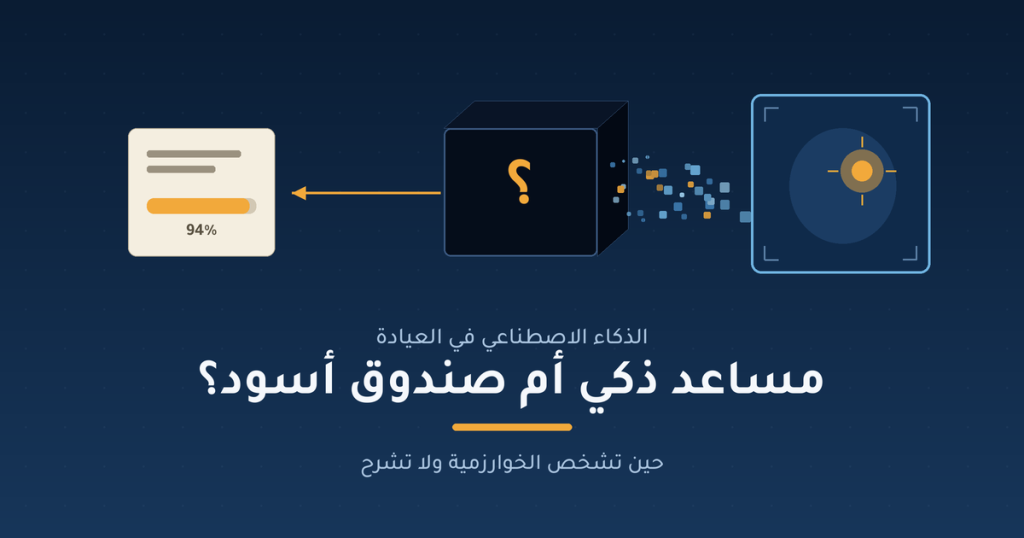
In a radiology room, a doctor has just finished examining a chest image and decided it is clear. Before moving on to the next case, an alert appears from the system: a suspicious area in the left lung, 94 percent probability of a tumour. The doctor zooms in, looks again, turns the image over, then asks the question any scientific mind would ask: why? On what basis?
The screen did not answer. The system gives the result but not the reasoning. That moment sums up the whole dilemma of medical AI: a decision that could change a person's life, coming from a box that does not explain itself.
Fairness before criticism
It would be unfair to start by scaring people. The truth is that algorithms have achieved things in medicine that deserve respect. Today's models read an image of the retina and detect diabetic eye disease before the patient feels anything, review millions of X-ray images and pick up patterns too fine for the human eye, and they do not tire at the end of a long shift or lose focus after the fortieth case.
The machine does not compete with the doctor in understanding, but it beats them in two things no human has: a memory that never fills up and a focus that never runs out.
The problem is not intelligence but silence
The dilemma begins when we ask the model for its reason. Deep neural networks, the heart of these systems, learn from millions of examples and build millions of mathematical parameters inside them, then produce a result without a clear path that can be traced. In practice they "feel" that this spot is a tumour, the same way you recognise a friend's face without being able to describe how you did it.
The problem is that medicine does not accept feelings. A doctor is trained all their life to justify their decision to colleagues, to the patient and, if necessary, to a court. So how can they sign off on a diagnosis that comes from a system they cannot question? Blind trust is reckless, total rejection is a loss, and standing in the middle without tools is the reality of most doctors today.
And why does it get things wrong at all?
Because it learns from our data, and our data is not innocent. A model trained on patients from one society stumbles with another. The best-known examples are skin disease models trained on light skin, whose accuracy dropped on dark skin.
And here is a point that concerns us specifically: our medical data is scarce and often not digitally archived at all, as we have seen in the articles of this series. The systems we import were trained on other people's patients, with their diseases, bodies and lifestyles. We are buying an intelligence that reads our patients through someone else's eyes, then we are surprised when it gets things wrong.
The solution has a name: explainability
The scientific answer to the black box is not to abandon AI, but to make it talk. There is a whole research field called explainable AI, whose goal is to turn "a tumour with 94 percent probability" into "this specific area triggered the model because of its density and the shape of its edges, and it resembles hundreds of confirmed cases it learned from".
The difference is not cosmetic. A heat map that shows the doctor where the model looked turns the relationship from dictation into dialogue: the doctor can agree, object, or discover that the model was fooled by the trace of an old operation. That is how the system becomes a real assistant instead of a mysterious priest handing down verdicts.
And if it gets it wrong, who is accountable?
It is a question no law in the world has fully settled yet: the doctor who trusted the system? The hospital that bought it? The company that developed it? The rule taking hold worldwide is that AI is an advisory tool, and the final decision and the responsibility belong to the doctor.
A logical rule, but it assumes something important: that the doctor is really able to understand the tool and question it. And so we come back to the same point. Without explanation, we are making the doctor responsible for a decision they had no part in making.
The right equation is not doctor against machine, but doctor with a machine they understand and can talk to. And the truly smart assistant is not the one with the highest accuracy on paper, but the one that shows you how it thought.
For anyone preparing an AI project in a hospital or clinic today, one question deserves a permanent place in the tender specifications before anything else: does the system explain its decisions? A black box is acceptable when it recommends a song, and completely unacceptable when it diagnoses a tumour.

























 English
 Arabic
