
Have you ever changed one class and accidentally affected many other parts of your application?
This usually happens because of tight coupling.
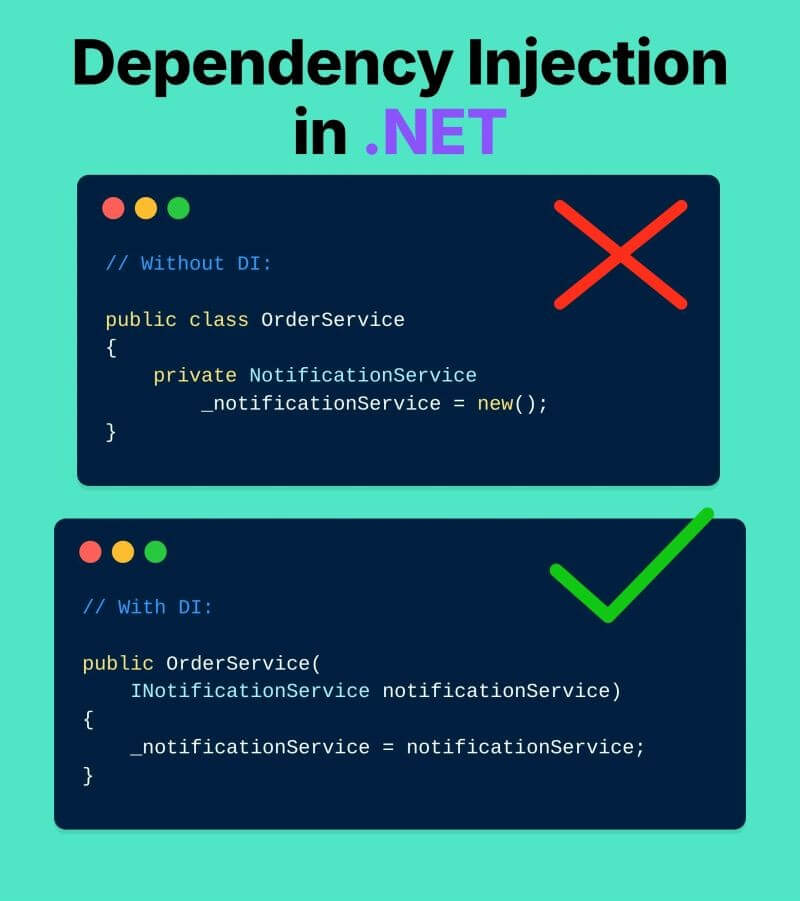
Dependency Injection (DI) solves this problem by allowing classes to receive their dependencies instead of creating them directly.
Now the class depends on an abstraction, not a specific implementation.
Benefits:
Loosely coupled code
Easier unit testing
Better maintainability
Flexible architecture
In ASP.NET Core, understanding service lifetimes is also important:
Transient → New instance every time
Scoped → One instance per request
Singleton → One instance for the application lifetime
Dependency Injection is not just a framework feature.
It is a design approach that helps us build software that can evolve with changing requirements.





























 Arabic
 English
