
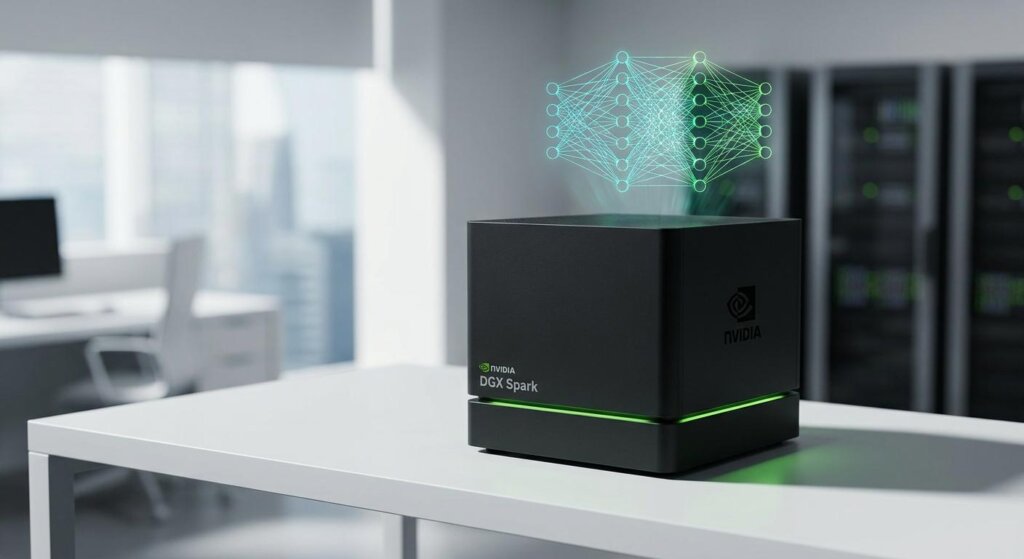
A new revolution in local computing opens wide horizons for researchers, developers and organizations
Artificial intelligence is no longer confined to giant data centers or expensive cloud servers. A new phase of computing has begun with NVIDIA's launch of DGX Spark, which offers a different concept of the personal computer by combining advanced processing and AI capabilities in a compact device able to run large AI models locally.
This device is not just an evolution in the specifications of traditional computers; it reflects a shift in how AI applications are built and run, giving developers and researchers an advanced computing environment on their desks without relying entirely on cloud services.
First: what is NVIDIA DGX Spark?
NVIDIA presents DGX Spark as a personal AI supercomputer. It is based on the NVIDIA Grace Blackwell architecture and combines CPU and GPU processing with unified memory in an integrated platform.
The main goal of the platform is to enable users to develop, run, customize and test AI models locally, including large language models, computer vision systems and multimodal applications.
Second: technical architecture and engineering design
The platform is built on the NVIDIA GB10 Grace Blackwell Superchip, which combines a 20-core ARM-based CPU with a GPU built on the Blackwell architecture.
Its key technical specifications include:
- A 20-core ARM CPU.
- A GPU based on the NVIDIA Blackwell architecture.
- Fifth-generation Tensor Cores to accelerate AI workloads.
- Up to 128GB of LPDDR5X unified memory.
- Memory bandwidth of up to 273GB/s.
- Stated compute performance of up to 1 PFLOP at FP4 with sparsity.
- NVMe SSD storage with capacities of up to 4TB.
- 10GbE networking and a ConnectX-7 interface with speeds of up to 200Gbps.
- Wi-Fi 7 support.
One of the most distinctive features of this architecture is unified memory: the CPU and GPU can access a shared, coherent memory space, which helps when working with large models that need more memory than many conventional graphics cards provide.
Third: why is unified memory an important development?
Traditional computers have separate memory for the CPU (RAM) and dedicated memory for the GPU (VRAM), which limits the size of the models that can run on a given graphics card.
In DGX Spark, 128GB of unified memory gives developers more flexibility in loading and running large language models and in carrying out deep learning and data analysis experiments.
It is worth noting that unified memory does not mean its full capacity is available to the model, as the operating system, applications and other processes need part of it.
Fourth: running AI models locally
The platform can run large language models of up to 200 billion parameters on a single device, given suitable operating and quantization conditions, and models of up to 405 billion parameters can be reached by using two devices in a supported configuration.
Possible applications include:
- Running local AI assistants.
- Analyzing texts, documents and records.
- Developing Arabic-language conversational systems.
- Fine-tuning pre-trained models.
- Building AI agents.
- Developing computer vision applications and image and video analysis.
- Carrying out deep learning experiments and scientific research.
The importance of local operation lies in keeping data within the organization's own infrastructure and reducing dependence on external AI services, while still applying information security controls, permission management and backups.
Fifth: the software ecosystem and its role in application development
The power of DGX Spark does not come from the hardware alone; it also benefits from NVIDIA's integrated software ecosystem, whose main components include:
- CUDA: For accelerating computations on the GPU.
- PyTorch: For building and training deep learning models.
- TensorRT-LLM: For optimizing the performance of language model inference.
- NVIDIA NeMo: For developing and customizing models.
- NVIDIA NIM: For delivering model services through APIs.
- NVIDIA RAPIDS: For accelerating data analysis.
These tools allow developers to move from experimentation to building practical applications that can be connected to enterprise systems, using APIs and specialized software services.
Sixth: engineering and scientific applications
This platform opens wide horizons in many sectors, particularly academic and engineering institutions.
1. Education and scientific research
Developing academic assistants, analyzing scientific research, summarizing references and building smart search systems based on reliable scientific sources.
2. Engineering and simulation
Developing predictive models, analyzing engineering data, simulating some industrial systems and making use of digital twin technologies.
3. Computer vision
Image and video analysis, object detection, occupational safety monitoring and developing smart systems based on cameras and sensors.
4. Drones and autonomous systems
Developing applications for aerial image analysis, object recognition, sensor data analysis and testing algorithms for autonomous systems.
5. Software development
Creating local coding assistants that can analyze source code, detect bugs and help developers build complex systems.
Seventh: towards smarter universities
One of the promising applications of this technology is the ability to create local AI centers inside universities, connected to academic and administrative systems and institutional databases.
For example, a smart university assistant could be built to search regulations, documents and curricula, answer questions from students and teaching staff, and analyze academic indicators and statistics.
This technology can also be used to build scientific research platforms, AI laboratories and environments for developing computer vision and engineering simulation applications.
This can be achieved by connecting DGX Spark to existing systems through secure APIs, without having to replace databases or rebuild institutional systems.
Eighth: can it replace traditional servers?
Despite its advanced capabilities, DGX Spark is not a complete replacement for enterprise servers and data centers.
It is designed primarily for AI development and for running and serving models, while large enterprise systems need a separate infrastructure for database management, storage, backup, load balancing and cybersecurity.
Its best use, therefore, is as a specialized AI unit that works alongside the existing infrastructure and provides intelligent services to other applications.
Conclusion
NVIDIA DGX Spark is not just a small computer with high specifications; it is an important step towards making advanced computing and AI available locally to developers, researchers and organizations.
As large language models, deep learning and computer vision continue to evolve, these platforms can help accelerate scientific research, develop education, raise the efficiency of enterprise systems and open new horizons for engineering and technical innovation.
The future of AI is not tied only to the size of data centers, but also to our ability to turn these technologies into practical tools available inside laboratories, universities and workplaces.


 English
 Arabic