
What if a robot became able to understand its surroundings, make decisions, learn from experience and then carry out complex work in the real world without needing to be programmed for every movement?
This is not a scene from science fiction; it is one of the most important technological directions taking shape in 2026, and it is known as Physical AI.
We are witnessing an important shift in the history of technology: after intelligent systems learned to handle text, images and sound, they are moving into a new stage in which they can perceive the surrounding environment and interact with it through robots, machines and industrial equipment.
In this article we will look at the technology, how it works, how it relates to industrial robots, and what it could change in the future of engineering and manufacturing.
First: what is meant by physical artificial intelligence?
Physical AI can be defined as the fusion of artificial intelligence models with devices, equipment and mechanical systems, so that a machine becomes able to perceive the real world, understand what is happening around it, take decisions and carry out actions autonomously or semi-autonomously.
To understand the difference, take a simple example:
- The traditional robot: it is programmed to pick a part up from one fixed place and put it down in another, and if the part moves it may fail.
- The robot powered by physical AI: it can see the part, determine its position and shape, work out how to pick it up, and then adjust the movement of its arm according to the surrounding conditions.
The essential difference here is the move from executing fixed instructions to perceiving the environment and adapting to it.
Second: how does this technology work from an engineering standpoint?
A physical AI system depends on the integration of several engineering and technical disciplines; it does not rest on a single AI model.
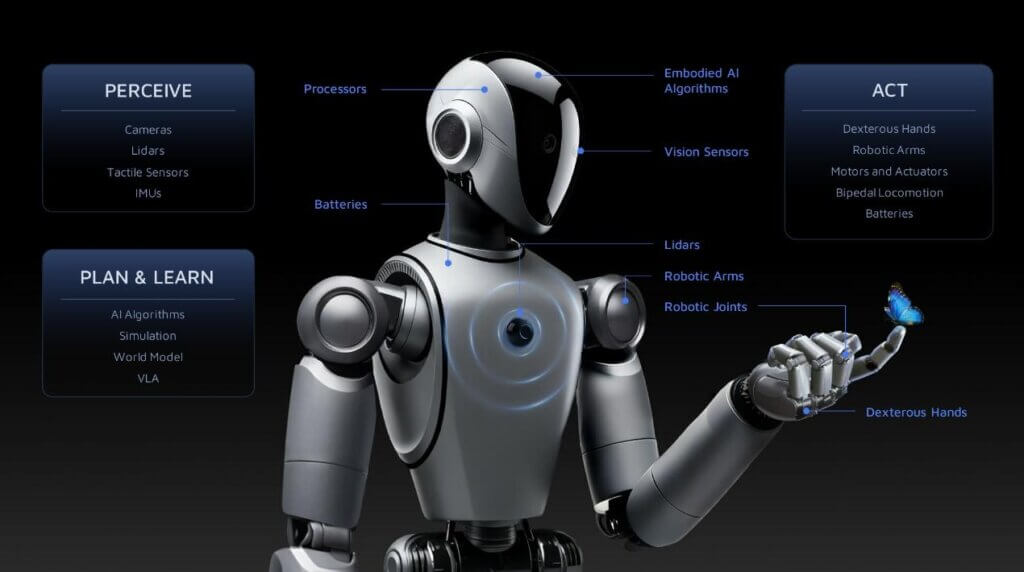
Its basic structure can be divided into five stages:
1. Sensing & Perception
The machine uses a set of sensors to obtain information about its surroundings, such as:
- Computer-vision cameras.
- LiDAR for measuring distances and building three-dimensional maps.
- An IMU for measuring acceleration, rotation and orientation.
- Force, pressure and touch sensors.
- Temperature and vibration sensors when working in industrial environments.
2. Understanding
The data is analysed using AI models and computer vision to identify objects, people and obstacles and to understand the spatial relationships between them.
3. Planning and reasoning
The system determines the right action to achieve the goal, taking account of physical constraints, safety, time and the resources available.
4. Actuation and control
Decisions are turned into control commands sent to the motors, joints and hydraulic and electrical systems.
5. Feedback and learning
The sensors monitor the result of the movement, the system compares that result with the goal, and then corrects its behaviour where needed.
Here lies the importance of closed-loop control: the robot does not execute a command and then stop thinking; it monitors the effect of every movement and continuously adjusts its response.
Third: the technologies behind Physical AI
Vision-Language-Action Models (VLA)
Models that combine vision, language and motion, turning human commands and visual information into actions the robot can carry out.
World models
They help the machine build a picture of its environment and predict what may happen if a particular movement is made, before it is actually made.
Digital twins
Creating a virtual copy of the robot or the factory to test movements and processes before applying them in reality.
Edge AI
Running inference and analysis close to the robot itself, to reduce latency and dependence on a cloud connection.
Reinforcement learning
Training the robot to improve its decisions through trial, reward and penalty, within a safe and controlled training environment.
Fourth: what is new in 2026? NVIDIA leads a new wave of intelligent robots
Among the most notable developments of 2026 is NVIDIA's expansion into building a complete ecosystem for developing intelligent robots.
The focus is no longer only on manufacturing a fast processor; it now extends to providing AI models, simulation environments, training tools and runtime platforms.
Among the most important technologies in this ecosystem:
- NVIDIA Isaac GR00T: models and tools for building humanoid robots and training them to understand tasks and carry them out.
- NVIDIA Cosmos: world models that help generate data and simulate physical environments for training intelligent systems.
- NVIDIA Isaac Sim: a simulation environment for testing robots and mechanical systems virtually.
- NVIDIA Jetson Thor: a computing platform built to run advanced AI applications on robots.
Another important development was NVIDIA's announcement in October 2026 that it was expanding the Isaac platform and adding new runtimes, learning frameworks and simulation environments, in cooperation with global robotics companies.
NVIDIA Investor Relations+2
This development matters because it narrows the gap between designing a robot, training and testing it, and then operating it in factories and real environments.
Fifth: where will we see physical AI applied?
Industry and smart factories
Robots able to handle different products, monitor production lines and assist with maintenance and assembly.
Smart agriculture
Robots able to monitor crops, identify weeds, spray pesticides precisely and harvest.
Warehousing and logistics
Self-driving systems that move and sort goods and manage warehouses without constant human intervention.
Energy and infrastructure
Drones and robots that inspect power lines, pipelines and industrial installations and detect faults.
Sixth: the relationship between Physical AI and electromechanical engineering
Electromechanical engineering is among the disciplines most closely tied to this technological revolution, because Physical AI cannot work without the integration of mechanical, electrical, electronic and software systems.
Take the industrial robot as an example:
Engineering discipline Its role in the system
Mechanical engineering Designing the structure, joints and motion
Electrical engineering Motors and power sources
Electronics Sensors and control units
Control engineering Regulating motion and response
Computer engineering Data processing and artificial intelligence
Systems and automation engineering Integrating and operating the system
This means that the engineer of the future will not only be required to understand the machine mechanically; they will need to understand how software and artificial intelligence interact with physical systems.
Seventh: what challenges does this technology face?
For all its potential, the move from digital artificial intelligence to physical artificial intelligence faces important engineering challenges:
1. Safety: any error in a robot's decision can cause material damage or human injury.
2. Response time: some control operations must be executed within tiny fractions of a second.
3. Sensor accuracy: inaccurate data can lead to wrong decisions.
4. Energy consumption: running processors, motors and sensory systems requires efficient energy management.
5. Cost: developing, training and testing intelligent robots is still expensive.
6. The simulation-to-reality gap: a robot's success in a virtual environment does not guarantee success in real conditions.
For this reason an AI model cannot be relied on alone to control every critical function directly; it must be combined with safe control systems, physical limits, emergency stop mechanisms and independent verification testing.
What Is Physical AI?+1
Eighth: will we have a robot that can work like a human being?
This is one of the most exciting questions in technology.
Humanoid robots are developing towards a wider range of abilities: walking, picking things up, using tools and operating in environments designed for people.
But a distinction must be drawn between the ability to perform a specific task and the possession of general human intelligence.
A robot that can stack boxes is not necessarily able to repair an engine or deal with an unexpected electrical fault.
The nearer future holds specialised robots with multiple capabilities, able to learn new tasks and adapt to different working environments, while human supervision remains necessary for sensitive operations.
Ninth: what does this mean for the future of industry in Iraq?
For Iraq, this technology could be an important opportunity to develop a number of sectors:
- Oil and gas: robots that inspect pipelines and tanks and work in hazardous areas.
- Electricity: intelligent systems for inspecting generation plants and transmission networks.
- Industry: improving production lines and reducing reliance on repetitive manual work.
- Agriculture: using robots and drones to monitor farmland.
- Engineering education: labs that bring robotics, control, artificial intelligence and digital simulation together.
It is important that universities begin developing teaching laboratories that bring together industrial robots, sensor systems, microcontrollers, computer vision and engineering simulation, because preparing an engineer for this shift requires practical, multidisciplinary experience.
Tenth: where is this technology heading?
The future of Physical AI can be summed up in three main directions:
- Multi-task robots: moving from a robot that performs one function to a robot that can learn a range of jobs.
- Self-operating factories: production systems in which robots and equipment interact with one another intelligently.
- Human–machine collaboration: moving from replacing people with machines to building shared workplaces where each side contributes what it does best.
We are not talking only about developing more intelligent robots, but about redefining the relationship between software and the physical world.
Conclusion
Physical AI is not merely a new stage in the development of artificial intelligence; it is the meeting point of computer science with mechanical, electrical and electronic engineering and control systems.
We have grown used to seeing artificial intelligence inside computers and phones, but the coming stage will make it part of factories, vehicles, medical equipment and industrial systems.




























 English
 Arabic
