
Generative AI tools and specialised AI agents have radically changed how software is written today. Tools such as GitHub Copilot, Claude Agent and Codex have become an integral part of developers' everyday toolbar.
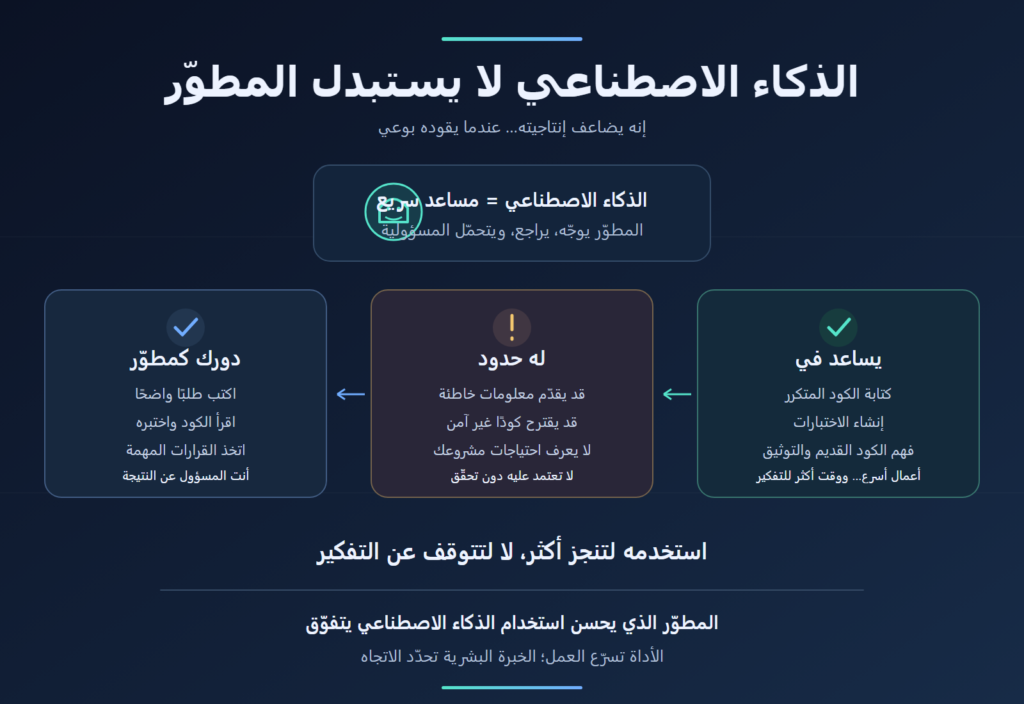
Even so, the programming community is split between those who see them as the developer's future replacement and those who think they are just autocomplete. The truth lies in the middle: AI is a productivity multiplier for the developer who knows how to direct it.
1. Where does AI excel? (The strength of the tool)
The strength of AI assistants shows in repetitive, time-consuming tasks:
Generating boilerplate code: writing data models (DTOs), setting up repetitive API endpoints, and creating the scaffolding for architectural patterns.
Writing unit tests: building test cases quickly by giving the AI the function to be tested, so it generates the possible success and failure cases.
Explaining and unpacking legacy code: helping you understand a complex function written years ago with no documentation.
Faster research and navigation between libraries: instead of reading a new library's documentation for hours, you can ask for a precise working example of the usage you need.
2. The hidden limits of AI (the risks of full reliance)
Despite its efficiency, AI has structural limits that the developer must make up for:
a. Hallucination and context loss
AI models do not "understand" code in the human sense. They predict the next word or line based on probabilities. They may suggest functions that do not exist at all, or practices no longer used in recent versions of frameworks.
b. Inherited security holes
If a model was trained on open-source code that contains vulnerabilities (such as unprotected SQL queries or excessive access permissions), it may suggest the same code with the same security holes without you knowing.
c. No understanding of the business logic
AI does not know how your company is run, what your client's exceptional requirements are, or how the subsystems will interact with each other. Key architectural decisions are purely human tasks.
3. How to get the most out of AI as a professional developer
Write precise prompts (prompt engineering for developers): instead of asking "build me a payment system", ask "write a C# function that calls the Stripe API, handles timeout exceptions and follows pattern X".
Review every line of code: do not auto-accept generated code without reading and understanding it line by line. You are the one responsible for the code in front of your team and in production.
Use it to automate documentation and testing: focus your human mental effort on solving complex problems and designing the system, and hand documentation and edge-case tests to the AI.
Conclusion
AI will not replace developers, but developers who master AI and use it efficiently will certainly replace those who refuse to adopt it.


 English
 Arabic